In an era defined by geopolitical conflict and global uncertainty, there exists an annual gathering that stands as a powerful counter-narrative. It is not a political rally, a music festival, or a sporting event. It is Arbaeen – a journey of faith, love, and collective humanity that transforms the deserts of Iraq into a sea of pilgrims, united in purpose and spirit.
Understanding Arbaeen: The Forty-Day Commemoration
The word “Arbaeen” derives from the Arabic term for forty, marking the fortieth day of mourning following Ashura – the martyrdom of Imam Husayn ibn Ali (AS), the grandson of Prophet Muhammad (PBUH), at the Battle of Karbala in 680 CE. According to historical accounts, it was on the fortieth day after the tragedy that the surviving family members of Imam Husayn – the women, children, and his son Imam Zayn al-Abidin (AS) – returned to Karbala to visit the graves of the martyrs.
In Shia tradition, the number forty holds profound spiritual significance. It represents the completion of a mourning cycle, a period after which the soul reaches a state of maturity. What began as a small gathering of grieving family members has, over fourteen centuries, transformed into the largest peaceful annual gathering on earth.
The Pilgrimage: A Journey of Devotion
The scale of Arbaeen defies imagination. In recent years, over 20 million pilgrims have participated, representing over 140 different countries. These pilgrims travel from various parts of Iraq, Iran, Pakistan, Lebanon, Yemen, Bahrain, Azerbaijan, Afghanistan, Saudi Arabia, Turkey, India, and even from nations as distant as the United States, Canada, and European countries.
The most iconic aspect of Arbaeen is the walk. The primary route stretches approximately 80 kilometers (about 55 miles) from the holy city of Najaf – where Imam Ali (AS), the first Shia Imam, is buried – to Karbala, the final resting place of Imam Husayn. Pilgrims typically complete this journey over three days, walking through the scorching heat of the desert sun and enduring the bitter cold of the nights. Many undertake even longer journeys, with some pilgrims walking hundreds of kilometers over tens of days to reach Karbala.
The Human Aspect: A Civilization of Service
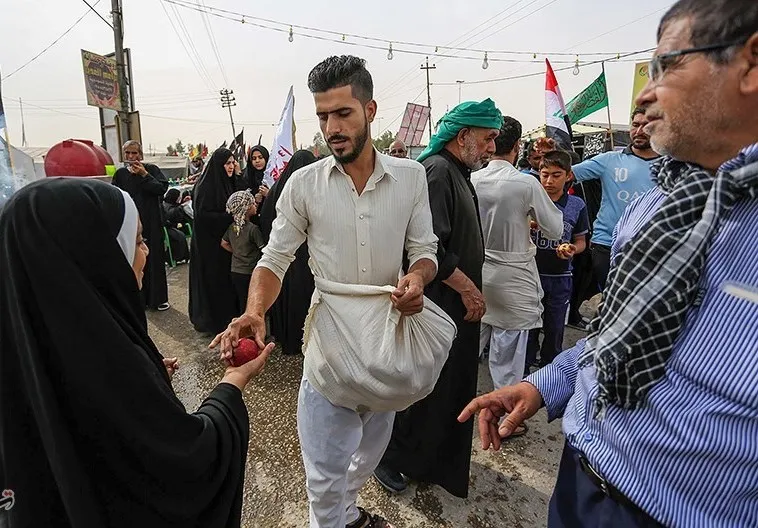
What makes Arbaeen truly extraordinary is not merely the number of pilgrims but the infrastructure of love that supports them. Along every route leading to Karbala, thousands of makeshift tents known as “mawakib” line the roads. These are not commercial enterprises or government-run facilities. They are volunteer stations operated by ordinary Iraqis – families, villagers, shopkeepers, and students – who open their hearts and homes to complete strangers.
At these mawakib, pilgrims receive everything they need, entirely free of charge. Freshly cooked meals are distributed in staggering quantities – over 400 million meals were provided during a single Arbaeen season, averaging approximately five main meals per pilgrim each day. Water is available at every turn, with more than 4 billion cups distributed annually. Volunteers offer cold juices, ice cream for refreshment, fruits, tea, and traditional Iraqi bread to pilgrims.
But the services extend far beyond food and drink. Many mawakib provide:
- Medical services: Doctors and nurses volunteer their time to treat blistered feet, dehydration, and other ailments.
- Resting areas: Tents with mattresses and blankets offer weary pilgrims a place to sleep.
- Free international phone calls: Volunteers set up phones so pilgrims can reassure worried families back home.
- Baby supplies: Diapers, formula food, and baby care items are freely available.
- Technical support: Some mawakib even offer free internet access and device charging stations
The spirit of service begins even before the journey does. Children as young as five stand by the roadside holding bottles of perfume to spray on passing pilgrims, or giving packets of tissues for them to wipe their faces. Teenagers carry coolers filled with chilled water. The elderly sit in chairs, offering prayers and blessings. Everyone, regardless of age or wealth, participates.
This tradition of hospitality is so unique and profound that UNESCO has recognized it as part of the world’s intangible cultural heritage.
Why Arbaeen Matters: Beyond Religious Ritual
Arbaeen holds deep spiritual and philosophical significance for Shia Muslims. It represents the triumph of moral principle over worldly power. Imam Husayn did not go to Karbala expecting military victory; he went because he refused to pledge allegiance to a tyrant. His stand, though ending in apparent defeat, became a moral victory that has inspired generations for over 1,300 years.
The fortieth day commemoration, in Shia thought, transforms personal grief into collective memory. It turns a historical tragedy into a living, revolutionary symbol – a permanent call to stand against injustice wherever it appears.
Transcending Religious Boundaries
Remarkably, Arbaeen has transcended sectarian and religious boundaries. While it is a Shia observance, participants include Sunni Muslims, Christians, Yazidis, Zoroastrians, and even people with no religious affiliation. Christian priests and clergy have been known to participate in the walk as well.
For many non-Muslims, Arbaeen represents something universal: the story of a righteous man who stood against tyranny, who sacrificed his life and the lives of his family members for the sake of justice and human dignity. Imam Husayn is not merely a figure for Shia Muslims; he has become a universal symbol of resistance against oppression, recognized by people of diverse faiths and backgrounds.
Overcoming Security and Logistics Challenges
The Iraqi government, working in coordination with security forces and various intelligence agencies, implements extensive security plans for Arbaeen. Surveillance cameras monitor crowds, checkpoints screen pilgrims, and thousands of security personnel are deployed along the routes.
The logistical coordination is equally impressive. New roads, bridges, and squares are constructed specifically to accommodate the crowds. Yet, despite the government’s role in security and infrastructure, the heart of Arbaeen remains – that of a grassroots movement of ordinary people serving ordinary people.
A Model for Humanity
For a few days each year, on the roads leading to Karbala, there are no rich or poor, no powerful or weak, no Arab or Iranian, no Muslim or Christian. There are only pilgrims – hungry, thirsty, tired, and utterly determined – and volunteers who compete with one another for the honor of serving them.
This is the miracle of Arbaeen. It is not sustained by governments or corporations. It has no central organizing committee. It relies entirely on the goodwill of ordinary people who believe that serving a pilgrim of Imam Husayn is the highest form of worship.
For the Shia Muslim, Arbaeen is an act of religious devotion, a renewal of allegiance to the principles of Karbala. But for any observer of the human condition, it is something more: a testament to the enduring power of love over hatred, generosity over selfishness, and community over isolation. In the deserts of Iraq, against all odds, millions of people walk toward a common destination – and in doing so, they offer the world a glimpse of what humanity could be.
Leave a Reply